
The Central Florida Business Owner’s Guide to Saving Your Inventory
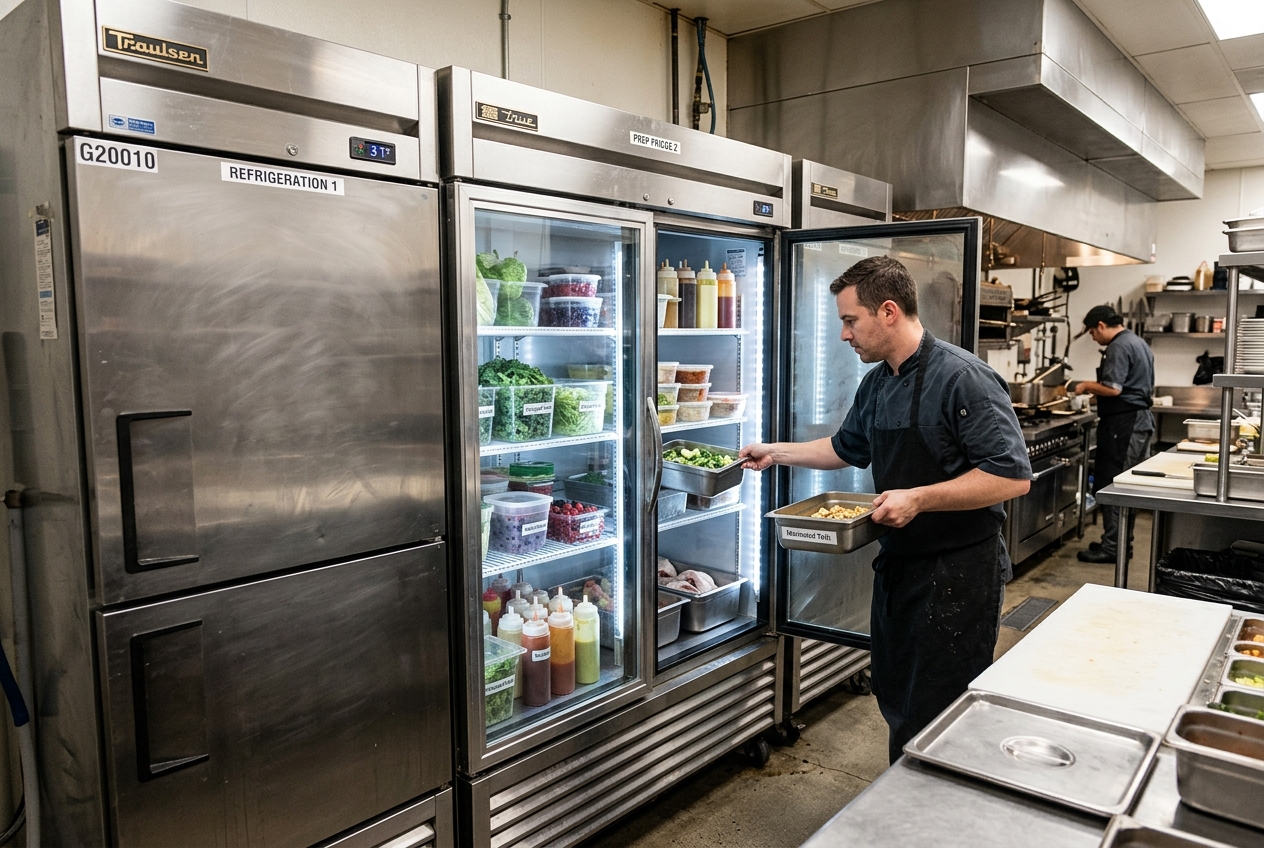
There is a specific kind of dread that every restaurant owner, grocery manager, and convenience store operator in Central Florida knows all too well. It’s that wave of humid, warm air hitting your face when you open your walk-in cooler door during a busy shift.
When your walk-in cooler stops cooling, the clock starts ticking. Thousands of dollars in inventory, from fresh produce to high-grade proteins,are suddenly at risk of entering the danger zone.
At EcoAir Refrigeration, we handle commercial systems every day across Central Florida. We know that when the outdoor temperature hits 95°F with 90% humidity in Largo or St. Petersburg, your refrigeration equipment works double-time. Before you panic-search for emergency repairs, let’s walk through a practical diagnostic triage.
Here is what you can check right now, what’s causing the breakdown, and exactly when you need to call in a certified technician.
The Immediate Triage Checklist: Check These First
Before assuming your compressor is dead, check these three common culprits. Sometimes, the fix takes less than two minutes.
1. The Power and Thermostat Settings
It sounds simple, but you would be amazed how often a tripped circuit breaker or a bumped thermostat dial is the root cause.
-
The Diagnostic: Check your commercial breaker panel. Is the switch for the condensing unit or evaporator tripped? Next, look at your digital controller or mechanical thermostat. Did someone accidentally change the setpoint during loading?
-
Expert Tip: If the breaker is tripped, flip it back once. If it trips a second time immediately, leave it off. It means your system has a direct electrical short or a locked rotor in the compressor, and forcing power to it can turn a minor electrical repair into a catastrophic system failure.
2. Airflow Obstructions - The Overstacking Problem
Commercial refrigeration relies entirely on static pressure and continuous air circulation to maintain uniform temperatures.
-
The Diagnostic: Step inside the cooler and look at the evaporator fan housing (the box with fans mounted on the ceiling). Are boxes of produce or crates of milk stacked directly against or underneath it?
-
The Fix: Clear at least 18 inches of clearance around the evaporator coils. If air cannot return to the fans, the coil cannot remove heat from the space, causing the box temperature to rapidly climb.
The Invisible Culprits: Why Central Florida Humidity is the Enemy
If the power is on and the airflow isn't blocked by inventory, the issue is likely mechanical or environmental. In Central Florida, our climate creates unique operational challenges that northern refrigeration systems rarely face.
Dirty Condenser Coils
Your walk-in cooler works by absorbing heat from inside the box and rejecting it outdoors or into a back-of-house mechanical room via the condensing unit.
Because Florida air is filled with dust, pollen, and airborne grease, the microscopic aluminum fins on your condenser coils act like a vacuum filter. When they get caked in grime, the heat cannot escape. The system undergoes high head pressure, causes the compressor to overheat, and eventually forces the system to shut down on its thermal overload safety switch.
Frozen Evaporator Coils
If you look up at your indoor evaporator unit and see a block of ice encasing the aluminum fins, your cooler cannot drop the temperature. Ice acts as an insulator, blocking heat exchange entirely.
Ice forms for a few distinct reasons:
-
Defrost Timer Failure: Walk-in coolers rely on timed defrost cycles to melt away normal frost buildup. If the mechanical defrost clock fails or the defrost termination switch dies, ice accumulates continuously.
-
Worn Door Gaskets: This is the number one issue we see in Central Florida. If your vinyl magnetic door gaskets are torn, brittle, or sagging, they create a microscopic gap. The relentless, moisture-heavy Florida air gets sucked into the cooler, hits the freezing coil, and instantly flash-freezes into massive ice sheets.
When to Call the EPA-Certified Technicians at Eco Refrigeration
If your coils are clean, your gaskets are sealing perfectly, and the fans are spinning, but the temperature is still climbing, you are likely dealing with a sealed-system failure. This requires professional diagnosis.
-
Low Refrigerant Charge / Leaks: Commercial systems are closed loops. If a system is low on refrigerant (like R-404A or R-448A), it means there is a physical leak. A technician must find the leak, brazed-repair the copper tubing, evacuate the system with a vacuum pump, and weigh in a fresh charge according to factory specifications.
-
Faulty Thermal Expansion Valve (TXV): The TXV acts as the traffic cop for your cooling system, metering the exact amount of liquid refrigerant entering the evaporator. If it gets stuck closed, no cooling happens; if it gets stuck open, liquid refrigerant floods back to the compressor, which can destroy it.
-
Compressor Short-Cycling: If you hear your outdoor condensing unit turning on and off every few minutes, it is "short-cycling." This is a severe warning sign indicating a failing start capacitor, a high-pressure safety trip, or internal mechanical failure.
Stop the Crisis Before It Starts: Proactive Maintenance
The absolute best way to handle a walk-in cooler that won't cool is to prevent the breakdown from happening in the first place. Commercial refrigeration systems aren't appliances. They are complex mechanical assets that require routine calibration.
Quarterly cleanings of your condenser coils, verification of refrigerant pressures, checking electrical contactors for pitting, and inspecting drain lines can extend the lifespan of your system by years and cut your commercial electric bill drastically.
If you are experiencing temperature fluctuations, don't wait until your inventory ruins. Explore our comprehensive commercial refrigeration services to see how we protect Central Florida businesses with expert diagnostics, rapid repairs, and tailored preventative maintenance agreements.
Is your walk-in cooler losing its chill right now?
Contact EcoAir Refrigeration immediately by calling (727) 334-7252 in Central Florida and (941) 221-9893 in SW Florida to get an expert technician out to your facility today.